Following-distance and tailgating alerts on your iPhone
Most rear-end crashes start with a gap that was too short to react in. Roadlert watches the car ahead through your iPhone’s rear camera, works out your following distance in seconds at your current speed, and tells you out loud when it is time to ease off.
The car ahead stops and you’re suddenly braking hard
- You only notice the gap has closed when brake lights flare.
- On a long highway drive the gap shrinks without you noticing.
- Nobody can count “one-thousand-one, one-thousand-two” while concentrating on traffic.
With Roadlert
Roadlert counts the gap for you, in seconds, and says “Keep your distance” while there’s still time to ease off.
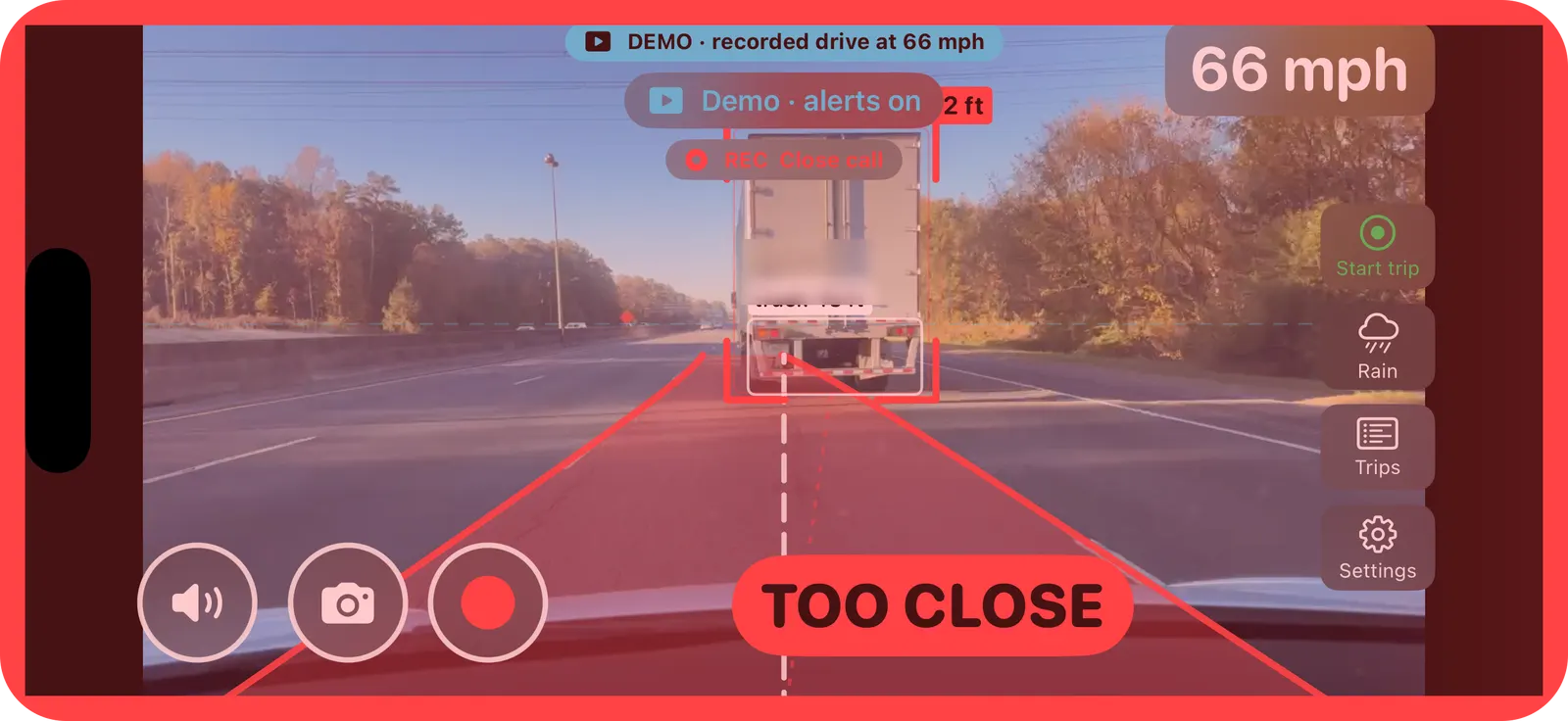
Screenshots from a real drive, replayed through Roadlert’s demo mode.
What you’ll hear
“Keep your distance”
Your gap drops below 1.2 seconds (yellow caution).
“Too close”
Your gap drops below 0.7 seconds (red warning).
“Closing fast”
You are closing on the car ahead quickly enough to reach it in about 2.5 seconds.
“Stopped traffic ahead”
A queue ahead is standing still and you are approaching at speed, up to 4 seconds early.
How it works
Measured in seconds, like the two-second rule
Distance alone means little: 60 feet is plenty in a parking lot and far too little on a highway. Roadlert combines the distance to the car ahead with your GPS speed to give the gap in seconds, the same measure driving instructors use.
It locks onto the vehicle in your lane, ignores cars alongside you and oncoming traffic on bends, and hands over cleanly when someone cuts in.
Adjusts to the conditions
Tap Rain and Roadlert asks for 1.5 times the usual gap. At night it asks for 1.25 times, detected automatically from the camera. A sensitivity setting (Low, Normal, High) lets you tune how early it speaks up.
Speaks up without nagging
A warning is beeped and spoken when it starts and once more, then stays quiet on screen until something changes: the car ahead gets closer, or the warning clears and comes back. You hear what matters, not a running commentary.
Good to know
- A driver aid, not a safety system: it can miss vehicles and it cannot brake.
- Distances are estimates from one camera and are less accurate at long range, at night and in heavy rain.
- Following-distance alerts start above about 10 mph, except for something very close or closing fast in front of you.
- Nothing warns until you are driving with the phone in its mount: opening the app in a parking lot, or holding the phone up, stays quiet.
Read next: The two-second rule: how much following distance you really need
Roadlert is a driver aid, not a safety system. Keep your eyes on the road, and set the app up before you drive off.